


In our Ideas Hub note on Unity, we briefly discussed mobile in-app advertising and the competition between Unity U 0.00%↑ and AppLovin APP 0.00%↑. The market’s reaction to both companies’ latest quarterly results prompted us to revisit the subject. We spent time digging into AppLovin, conducting interviews, speaking with industry experts, and studying the market. Along the way, our view of the business’s prospects swung from one extreme to the other several times. One thing became clear: AppLovin is one of the most unusual companies in the industry.
We originally intended to publish a full Deep Dive covering the company’s history, its opportunity in e-commerce, unit economics, growth prospects, valuation, and, of course, competition. But developments have been moving so quickly that we decided to publish a series of articles under Grana Insights instead.
This is the first of three articles on AppLovin. It explores the company’s history and how it built a walled garden within the open internet. Part two will examine its expansion into e-commerce and what this new vertical means for the business. Part three will focus on the main risks.
This first installment sets the scene, explaining what has made AppLovin so successful in mobile gaming. For investors, however, the central questions are how much potential e-commerce holds and how well the company can defend its competitive position. It faces competition in both user acquisition and mediation.
Please subscribe to receive the next installments, and consider sharing this article.
Return on Luck
In their 2011 book “Great by Choice”, Jim Collins and Morten Hansen studied companies that achieved extraordinary success amid chaos and uncertainty, comparing them with less successful competitors. They found that the winners were not consistently luckier. What set them apart was their ability to make the most of fortunate circumstances — a concept they called “Return on Luck.”
Looking at the evolution of mobile in-app advertising, at least two turning points helped AppLovin become a market leader. The shift from waterfall mediation to in-app bidding allowed it to establish a dominant position in a market controlled by established players. Apple’s changes to its privacy policies then sharply increased the value of AppLovin’s proprietary data.
Still, the company deserves considerable credit. From the outset, AppLovin’s management has focused on two things: exceptional operating efficiency (former employees describe a culture closer to an investment bank than a Silicon Valley tech company) and a long-term approach to strategic planning. Almost every major leap the company made during periods of industry upheaval rested on decisions taken five years earlier.
AppLovin initially operated exclusively on the demand side. Mobile game developers used its platform to acquire new players. Drawing on its own algorithms and datasets, the company estimated how likely a user was to install an app, how much revenue that user might generate for the developer, and how much the advertiser could afford to pay to acquire them. The more accurately the platform valued an impression, the better the ROAS it could deliver. In 2012, AppLovin could not raise even $1 million in venture funding. By 2016, annual advertising spend on its platform had reached roughly $500 million.
According to an expert at Epic Games, AppLovin’s management already understood the risks of relying solely on third-party identifiers such as IDFA and GAID. In 2016, the company decided to build independent identification systems. Around the same time, it began to recognize that its existing data was insufficient to establish a lasting advantage in valuing ad impressions. It needed to understand what happened after a user installed a game: whether they kept playing, watched ads, made purchases, and what their lifetime value ultimately turned out to be.
After the attempt to acquire AppLovin for $1.42 billion (the deal was blocked by regulators), Chinese investment firm Orient Hontai Capital retained a 9.98% stake in the company and provided $841 million in debt financing. In July 2018, KKR invested $400 million for a minority stake, valuing the company at $2 billion. AppLovin used this dry powder to expand into both ends of the value chain simultaneously.
In July 2018, AppLovin launched its publishing arm, Lion Studios, marking the start of its push to acquire game studios. Owning mobile games gave the company access to first-party data on installs, retention, engagement, and willingness to pay — the signals it needed to better predict player value. Here is how one of AppLovin’s competitors at the time described it:
“In 2015 and 2016, we were seeing this behavior that AppLovin was performing where a lot of people laughed and mocked them in the sense that, one, besides focusing on becoming an ad network, they were also acquiring studios.
The studios were very strategic. One was Machine Zone. People were wondering like, “How in the world was there any relation with that?” Subsequently, they were also building some studios from diversifying their portfolio of non-gaming and gaming, but mostly the gaming side with hyper-casual, with casual titles, with blocks and puzzles, and so forth. The biggest crux of this acquisition was that they were hiring all the data engineers from the likes of Machine Zone and other companies to build their UA algorithm.
When that happened, they were, one, ahead of the game. Two, they were also trying to provide this ecosystem where they were acquiring games, and then they had this network.”
According to Adam Foroughi, roughly 200 million users played AppLovin’s own games each month (Q2 2021 earnings call). This created its first closed feedback loop: the company acquired a user, observed their behavior within a game, estimated their value, trained its model on that data, and applied what it learned to future user acquisition.
Still, Adam acknowledged that they had never been game developers at heart. In 2025, AppLovin sold its apps business to longtime customer Tripledot for $400 million in cash and an approximately 20% stake in Tripledot. AppLovin therefore retains a stake in a major mobile game developer with 25 million daily active users. Judging by the warm comments from both management teams, the companies continue to work closely together.
In September 2018, AppLovin acquired MAX, a small startup whose mediation platform managed in-app header bidding. One of MAX’s founders was Jim Payne, who had previously co-founded MoPub, a mediation platform then owned by Twitter. Established players dominated the market at the time: Google’s offering had been around for ten years, ironSource’s — now part of Unity — for eight or nine, and MoPub was another major competitor. Yet within just two to three years, MAX captured the lion’s share of the market. Here is how Adam Foroughi described it on the Q4 2025 earnings call:
“There’s Facebook, there’s Google, there’s Unity and if go down the last, 15 to 20 to maybe 100. and they get really small at the end, but at the head, there’s a lot of diversity there. The tool has to give a completely fair unbiased auction approach to the publisher to get the best ad from the highest paying network on every instance to be useful. We built MAX completely unbiased, completely transparent on data to the partners that we have, fully audited solution. And when we brought it to market, we were 10 years later than Admob’s solutions for publishers.
We were maybe 8 to 9 years later than IronSource’s solution from publishers. We were also competing with MoPub at the time. MAX went from 0 to probably 1/3 of the market in 2 to 3 years. This was before we had our demand-side platform strength. So if you just then go grade the technology that we built, we then bought MoPub, took over more of the supply in the space.”
MAX’s success owed much to the quality of its product. The platform pioneered the widespread adoption of in-app bidding while competitors still relied on traditional waterfalls, which required publishers to continually adjust floor prices manually. This fundamentally changed the economics of mobile apps. In an interview with AdExchanger at the time, Foroughi said that “There are a lot of people out there talking about wanting to do in-app header bidding.” AppLovin wanted to accelerate that transition rather than wait for the industry to make it on its own.
In April 2021, AppLovin completed its acquisition of Adjust, one of the largest mobile measurement platforms, for approximately $1 billion. Adjust’s SDK is integrated into an advertiser’s app to determine whether an ad impression or click led to an install and subsequent actions, such as a purchase, level completion, or subscription. The acquisition filled gaps in AppLovin’s ability to measure advertising performance and target users accurately. The platform’s extensive data likely became an important resource for improving the accuracy of ad matching. Adjust generates revenue through subscriptions.
In late 2021, AppLovin announced its acquisition of MoPub from Twitter for $1.05 billion. At the time, MoPub was a major player in mobile mediation, connecting 45,000 mobile apps and 1.5 billion users worldwide. Competitors such as Google and Unity tried to lure publishers to their own mediation platforms, including through direct cash incentives. But the acquisition also brought AppLovin the MoPub Marketplace, an ad exchange that had been a significant source of publisher revenue for years. Using that leverage, along with $210 million in incentive payments, AppLovin ultimately migrated more than 90% of MoPub’s customers to MAX.
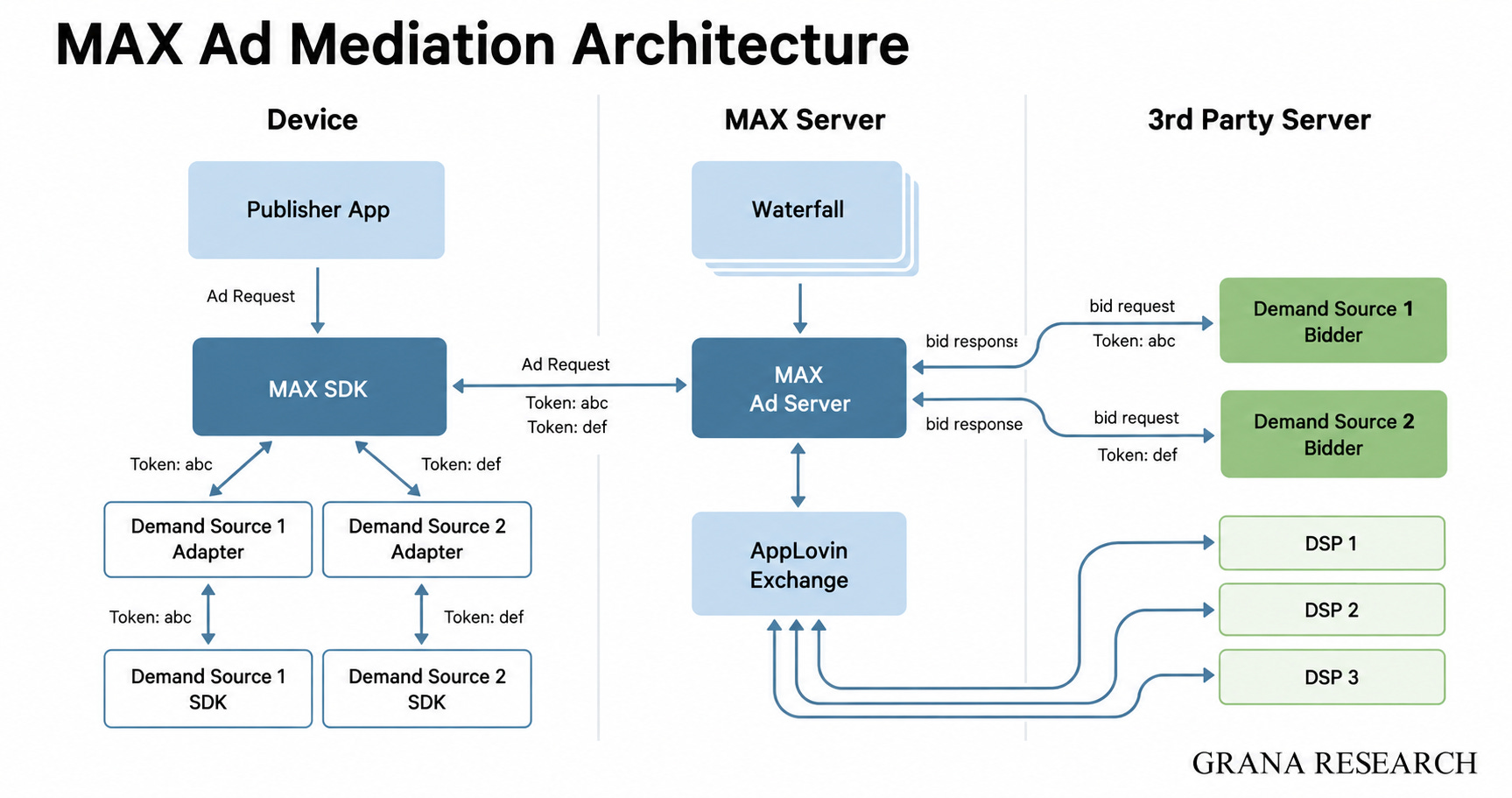
In our view, this was AppLovin’s most important acquisition because it allowed the company to consolidate the mediation market. The deal made MAX the largest mobile gaming mediation platform. According to GameBiz estimates, MAX holds a 73% share among the top 200 most downloaded games and a 55% share among the top 200 mobile games by in-app purchase revenue.
Analysts tend to give MAX far less attention than it deserves because mediation accounts for only a small portion of AppLovin’s revenue. The platform charges the winning ad network a 5% fee, unless AppLovin wins. Yet the company’s entire competitive advantage rests on the first-party data it collects, and MAX is the primary source of that data.
Ad networks bidding through another company’s mediation platform have limited visibility. Under the OpenRTB standard, a bid request primarily provides technical information — device type, operating system, and sometimes an IP address — along with the app identifier, ad format, user location, and floor price. The network bids on that information and learns the outcome through a brief win or loss notification. It cannot see how the auction unfolds: who bids or how other networks value the player. It therefore has little sense of how much it has overpaid or underpaid to reach that user. Only the winning network gets to show an ad, so only that network — and Adjust — can track the resulting click and subsequent install or purchase.
As the owner of the mediation platform, AppLovin has full visibility into the auction process and user activity within the app. MAX sees every incoming bid from more than twenty SDK-based ad networks, including Google, Meta, and Unity. This reveals both pricing information and signals from competitors’ bidding behavior. For example, if Google or Meta bids aggressively for a particular user, MAX can infer that the user may be valuable even if AppLovin initially had no data on them. The platform records the exact revenue generated by each impression — known as impression-level revenue data — and identifies users who watch more ads than others. Adjust provides more detailed information on in-app activity, including purchases, registrations, and the user’s journey over time. AppLovin uses all of this data to train its models. AXON therefore learns from vast amounts of proprietary data across the market, while competitors must rely on data from the auctions they win.
After reviewing expert interviews and speaking with industry professionals ourselves, we concluded that owning a mediation platform is AppLovin’s key advantage. One executive at a competing company put it this way:
“Just think of it as you and I are taking a test, and you have all the answers, and you’re able to fill it out without any issue or even ahead of time, while I’m still lagging behind trying to figure out whether the answer is filled in correctly or not. I would say it’s a very similar comparison to what AppLovin has with this whole walled garden in this ecosystem.”
By this point, AppLovin had assembled almost everything it needed to build a walled garden: demand through AXON, control over the auction process through MAX, measurement of player value through Adjust, and first-party outcome data from its own games. One final step remained: bringing these pieces together and building the best algorithm for user acquisition.
The first version of AXON launched in 2020, but the decisive technological leap came in Q2 2023 with the release of AXON 2.0. The new model benefited from infrastructure that had not existed just a few years earlier: a vast supply footprint through MAX, advertiser relationships and conversion feedback, years of mobile gaming campaign data, and an in-house measurement business.
Following the launch, AppLovin’s mobile game advertising revenue grew 76% year over year in 2023, 75% in 2024, and a further 53% in 2025, based on estimates excluding the contribution from e-commerce. Its share of the mobile game advertising market rose from ~12% in 2022 to ~40% in 2025.
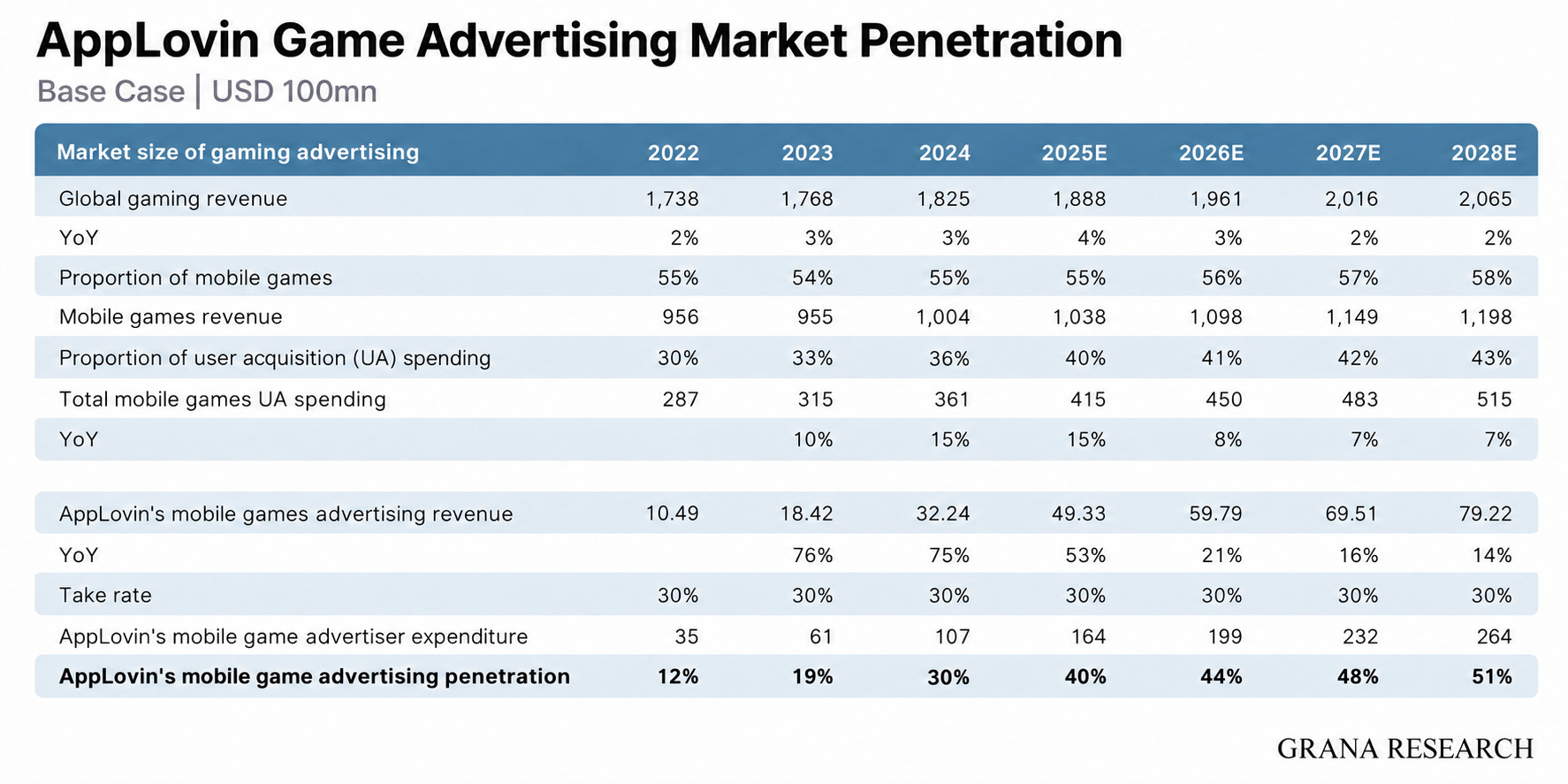
AXON 2.0’s effectiveness is beyond dispute. Yet few realize that the fivefold growth between 2022 and 2025 was driven primarily by a shift in share within MAX’s own mediation ecosystem. By our estimates, AppLovin’s own demand historically accounted for 10-15% of MAX auctions, rising to 50-60% after the launch of AXON 2.0. Most of the traffic AppDiscovery buys comes through MAX, with relatively little sourced from third-party mediation platforms. We estimate that AppLovin accounts for only ~20% of traffic purchased through Google’s AdMob.
According to a former Unity Software director, mediation platforms giving priority to their own ad networks is standard industry practice. Google itself buys roughly 50% of the traffic on AdMob, while Unity accounts for a similar share on LevelPlay. This suggests that owning a mediation platform gives an ad network a substantial advantage, rooted in access to better data.
But how secure is AppLovin’s position in mediation, given that MAX is essentially an SDK embedded in an app? At first glance, replacing one software library with another looks like a routine technical task. In practice, MAX is one of the stickiest products in the industry, for several reasons.
The technical complexity of switching and the risk of a temporary revenue loss. One expert we spoke with rated mediation’s stickiness at 8-9 out of 10. Switching involves more than replacing an SDK: it affects the publisher’s entire revenue measurement setup and requires reconnecting every demand partner. Their studio’s last migration took three to four months, at times requiring one specialist to work on it full-time. The same expert put the likelihood of switching platforms in the near term at 10-20%, noting that a move would require a mid-single-digit percentage uplift in revenue to justify the costs.
The highest CPMs among mediation platforms. We estimate that MAX generates roughly 10-15% more revenue for publishers than competing solutions. This advantage stems primarily from access to AppLovin’s own demand, optimized for MAX inventory. With AppDiscovery accounting for ~60% of a publisher’s revenue on MAX, a technical migration becomes a financial decision.
The link to AppDiscovery. AppLovin bundles user acquisition with mediation. Its user acquisition performance is the best in the market. A manager at mobile game developer Hyper Hippo puts it plainly: campaigns run through AXON deliver noticeably better results than the same budget spent on a competing network. A publisher wishing to run campaigns must first adopt MAX and integrate its impression-level revenue reporting interface, giving AXON the monetization data it needs for optimization. In other words, access to the best user acquisition tool is technically tied to the use of MAX. This is a key reason publishers stay.
In our view, AppLovin’s key advantage lies in how its assets work together. MAX provides scale, visibility into auctions, and access to ad inventory. Campaign outcome data helps improve AXON. A more effective algorithm attracts advertiser budgets and increases publisher revenue, reinforcing MAX’s position. Replicating this loop is considerably harder than building a standalone ad-buying algorithm. This is how AppLovin has built its own walled garden within the open internet.
Past achievements, however, do not guarantee investment returns. Markets look ahead. Much of the growth following AXON 2.0’s launch came from increasing AppLovin’s share of demand within MAX. That opportunity has limits, so the company’s future growth increasingly depends on attracting new advertising budgets and extending its technology beyond mobile gaming. Its expansion into e-commerce is a crucial test of whether AppLovin’s advantage can carry over to other markets. That will be the subject of our next installment.