


When we created Grana Research, our goal was to show how investment decisions are made in practice within a small buy-side firm — from the initial screening of ideas and the construction of a watchlist to initiating a position and managing it over time. Every investment passes through a kind of funnel: dozens of companies may appear interesting at the top, but only a small number ultimately make it into the portfolio.
Ideas Hub represents the top of our investment funnel. Here, we highlight companies that have recently caught our attention and merit further research. Some ideas emerge from sell-side research, quarterly fund letters, or Substack publications; others arise from our own observations and analysis.
While most Ideas Hub posts will feature short collections of investment ideas, from time to time we will also publish standalone investment theses. The first of these is dedicated to Unity Software U 0.00%↑.
The Company
Unity is one of the leading platforms for creating, launching, and operating games and interactive content. The company offers a suite of tools spanning all major devices and environments, including mobile platforms, personal computers, consoles, and extended reality. In particular, Unity develops one of the world’s two leading game engines — software platforms used by developers to build 3D games and interactive content.
Unity’s platform consists of two complementary segments:
Create Solutions. A suite of tools that developers use to create, launch, and maintain real-time 2D and 3D content. At the core of this segment is the Unity game engine. A game engine is the technical foundation and “construction kit” used to build a game or interactive 3D application: it determines how characters move, how lighting and graphics are rendered, and how sound, physics, interfaces, controls, networking, and player interactions function.
Beyond the engine itself, Unity’s ecosystem includes an integrated development environment, graphics and animation tools, and solutions for audio, user interfaces, networking, navigation, and multiplayer projects.
More than 70% of the world’s top 1,000 mobile games were built using Unity technologies, while the engine is used in 82% of the top 100 mobile games — not only during development, but also for subsequent updates and ongoing support.
Unity also maintains a significant presence in the PC market: more than 50% of games on Steam are built with Unity.Grow Solutions. Solutions for growing and monetizing games, primarily related to Unity’s advertising business. They help developers acquire users, retain audiences, and monetize content, regardless of whether it was built with the Unity engine. This segment includes Unity’s advertising network, a platform for managing ad placements, tools for in-app advertising offers, and Supersonic, a publishing solution that helps smaller studios and independent developers launch mobile games and improve their commercial performance.
Another product, Aura, helps developers promote applications directly on users’ devices, while enabling telecom operators to better monetize their audiences throughout the device lifecycle.
Taken together, Unity’s solutions support developers throughout the entire product lifecycle — from launching a game to acquiring users and monetizing it. This makes Unity one of the gaming industry’s core infrastructure platforms.
Importantly, Unity’s customer base has historically remained remarkably resilient despite years of operational missteps within the company (discussed below). Once a developer chooses Unity to build a game, they typically remain on the engine throughout the project’s entire lifecycle — and often use it again for future titles. Migrating to another platform requires rebuilding much of the development workflow: adopting new tools, transferring libraries of art and game assets, rewriting portions of the codebase, and re-establishing the production pipeline.
Unity’s large developer community also remains one of its key competitive advantages. As more studios build products using the Unity engine, third-party platforms have stronger incentives to integrate with Unity and streamline content deployment on their own ecosystems. This reinforces a powerful network effect: developers can more easily distribute games and interactive applications across multiple devices and platforms, while Unity retains its position as one of the industry’s leading development platforms for real-time 3D content.
Management Crisis
Unity is a strong business that has been held back by years of management missteps.
The company’s $4.4 billion merger with ironSource — an Israeli platform specializing in mobile advertising, app monetization, and user acquisition — proved unsuccessful and became one of the most controversial decisions in Unity’s history. ironSource went public at the height of the SPAC boom with an $11.1 billion valuation, making it the largest IPO ever by an Israeli company. By the time the merger with Unity was announced in July 2022, however, its market capitalization had fallen to roughly $2.3 billion. As a result, Unity’s offer represented a substantial premium of approximately 75% to the prevailing market value.
The rationale behind the transaction was straightforward: combine two complementary parts of the gaming ecosystem. Unity owned the development side through its game engine, while ironSource specialized in monetization, advertising, and user acquisition. In practice, however, Unity chose not to build upon ironSource’s advertising network. Instead, management shifted its focus to Unity’s own advertising infrastructure and the Vector platform. This strategic pivot was accompanied by the departure of several former ironSource executives, including founder and former CEO Tomer Bar-Zeev.
As a result, a significant portion of the acquired assets has since been either shut down or put up for sale. The closure of the ironSource advertising network and the planned divestiture of Supersonic effectively complete the dismantling of ironSource’s business within Unity. Supersonic is the mobile game publishing business behind titles such as Bridge Race, Going Balls, and Build A Queen.
Following Apple’s iOS 14 privacy changes, Unity also struggled with the accuracy of its advertising products and the consistency of advertisers’ return on ad spend (ROAS). Advertisers were no longer able to optimize campaigns effectively: even if they adjusted budgets to compensate for the algorithm’s previous week’s errors, the deviation could change the following week again. Combined with the post-pandemic slowdown in digital advertising spending, these shortcomings became increasingly apparent relative to competitors.
As a result, Unity’s advertising business rapidly lost market share to AppLovin APP 0.00%↑.
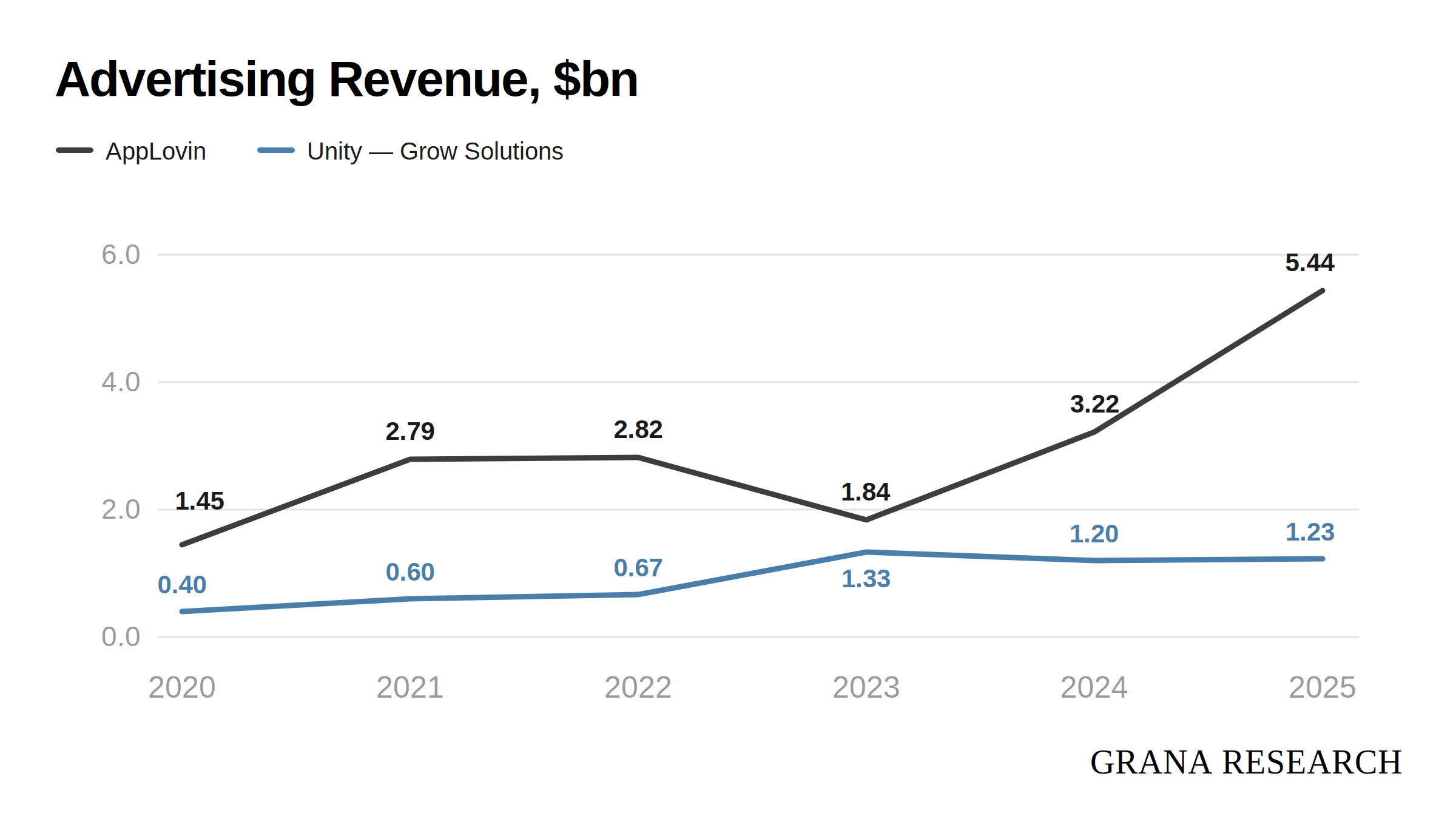
This is how a former Senior Director at Unity described the situation:
“The problem that Unity had in addition to that is, because they were charging per impression and the accuracy wasn’t there, it was also not consistent. What would happen is, let’s say we had a goal, we were off by 30%. They adjust their budget, the goal, down by 30% so that they can actually hit the real goal, or up by 30%, other way. The problem is, the next week when it came back, we’d be off by more than 30% or less than 30%. They couldn’t play optimization game. Effectively, I think that’s the big thing.
The big problem is, the performance wasn’t there in ROAS and the consistency wasn’t there in ROAS product for that month period after the iOS 14 thing. When the world looked up again and people started playing less games, then the budget shrank a little bit, and everybody was deciding where they wanted to spend. It led to a larger [direct] client Unity than our competitors. That’s what happened in that time, from my perspective. Two things happened in concert. We had that weakness on our demand, which impacted our overall revenue, which impacted our share price in the short-term view for investing. At the same time, we were building and launching and we were signing contracts for Unity mediation. AppLovin and ironSource, one of those other people thought that as a threat.”
Notably, in August 2022 — after the ironSource acquisition had already been announced — AppLovin made a non-binding proposal to merge with Unity. The company valued Unity at approximately $20 billion, or about $58.85 per share, representing a 48% premium to Unity’s closing price on July 12. The transaction was structured as an all-stock deal. However, Unity’s board of directors unanimously rejected the offer.
In 2023, Unity made another major mistake by introducing the Runtime Fee, a new charge based on game installations. Until then, Unity’s pricing model had been relatively predictable: smaller studios could use the engine for free, while larger developers paid for licenses and subscriptions to development tools. Under the new policy, however, developers would be charged for every game installation once a title exceeded both $200,000 in revenue over the previous twelve months and 200,000 lifetime installs. The fee could reach as much as $0.20 per installation.
For developers, this amounted to changing the rules in the middle of the game. Many studios had spent years building projects on Unity, and the new pricing model could apply even to games that were already in development — or had already been released.
The backlash was immediate. Developers feared unpredictable and potentially uncontrollable costs. The controversy quickly spread beyond social media: studios signed open letters, threatened to move projects to competing game engines, and some mobile developers even disabled monetization through Unity Ads and ironSource in their games. The concern was straightforward: a user could download a game, spend little or nothing, uninstall it, and then reinstall it, while the developer could still be charged by Unity. Similar concerns applied to free giveaways, demo versions, and games distributed through subscription services. As a result, developers viewed the Runtime Fee as a threat to the economics of their businesses. Unity was ultimately forced to reverse course. In 2024, the company abandoned the Runtime Fee entirely and returned to a traditional per-seat subscription model.
The controversy came at a high cost. It severely damaged developers’ trust in the company and accelerated a leadership transition, with John Riccitiello stepping down as CEO in October 2023.
“When you unilaterally try to change the contract on everybody, game devs everywhere went, That’s terrible. Even though the CEO who did that is gone, they walked back those plans. They’ve tarnished the brand reputation pretty heavily. I’m not saying that nobody uses Unity anymore. Unity is objectively a more tool-rich platform than a place like Godot. Godot, as well, the other way people pronounce that, which is open source and free. There are a lot of indie developers who have switched over to an open-source engine where there is no cost.
There’s no risk of getting screwed by a company that has decided it needs to make more revenue off of you. That’s a real thing that has happened. As somebody on the game’s publishing side, 98% of everything that came through was in Unreal or Unity. Now it’s probably down to 90% is Unreal Unity and Godot. Godot used to be half of the 2%, and now it’s 15%, 20% of the total that comes through. It’s a noticeable and measurable shift in small-game developer behavior.” – Current Product Director at Epic Games
In May 2024, Unity appointed Matt Bromberg as CEO, and his background is well aligned with what the company needs today. Before joining Unity, Bromberg served as Chief Operating Officer at Zynga, the mobile and social gaming company behind franchises such as FarmVille and Words With Friends.
Over the following five years, Bromberg reshaped Zynga’s monetization strategy, data infrastructure, and live operations — including post-launch game support, regular content updates, in-game events, and player retention. By the time he departed at the end of 2021, Zynga had become one of the more profitable operators in the mobile gaming industry. Just a few months later, the company was acquired by Take-Two for approximately $9.86 per share — nearly four times the share price at which Zynga was trading when Bromberg joined.
A Next-Generation Advertising Platform
Following the ironSource acquisition, Unity’s advertising business became overly complex and fragmented. The company was simultaneously operating Unity Ads, ironSource’s advertising infrastructure, and related assets such as Supersonic. Today, Unity is simplifying the business by consolidating it around two core assets: the Unity Ad Network and Vector. In March 2026, Unity announced that it would shut down the ironSource Ads Network and pursue the sale of Supersonic, aiming to eliminate non-core advertising assets and accelerate the growth of its core advertising business.
The centerpiece of Unity’s strategy is now Vector — a next-generation advertising platform that replaces the company’s legacy systems with a single unified machine learning model for ad targeting.
Following Apple’s 2021 privacy changes, mobile advertising became significantly more challenging. Advertising platforms lost broad access to IDFA (Identifier for Advertisers), Apple’s device identifier that had previously enabled user tracking across applications. As a result, the industry was forced to rebuild targeting capabilities using device fingerprinting and probabilistic attribution models.
For Unity, however, these changes had the potential to become a competitive advantage. Unlike traditional advertising platforms, Unity is not only an ad network but also the game engine behind a large share of the world’s mobile games. This gives the company access to proprietary signals that do not rely on IDFA. These signals are generated within the application itself, on the user’s device, and with the developer’s consent.
Unity can observe not only ad clicks and app installs, but also how users behave inside the game: session length, in-game purchases, churn points, level progression, and many other engagement metrics. By comparison, AppLovin primarily sees users through the lens of advertising — bids, clicks, installs, and the post-install events that developers choose to share with the platform. While these data are highly valuable, they do not provide the same depth of insight into in-game behavior.
Previous management failed to capitalize on Unity’s unique gameplay data as effectively as competitors leveraged their advertising data. That is precisely where the new management team sees the opportunity. Vector is designed to unify Unity’s proprietary signals into a single machine learning model for ad targeting and user quality prediction.
According to the Head of Programmatic & Video at a leading media agency, Vector represents a significant step forward for Unity:
Interviewer
Have you tested Unity’s new Vector optimization platform? How does it compare to Unity’s prior optimization tools?
Head of Programmatic & Video at Media Agency
Yes. Vector’s new optimization platform compared to its legacy optimization tools, for example, with ironSource’s LevelPlaybasic optimizers, certainly represents a fundamental shift to more deterministic neural modeling.
Vector is not just really anupgrade but is a complete rebuild designed to achieve parity with AppLovin’s Axon 2.0.
Ultimately, the prior tools for Unity reallyrelied on heavily historical averages, broad cohort-based bidding, whereas now, Vector’s certainly moving towards more real-timeper impression-based decisioning.
That is certainly speeding up the learning phase now, cutting it down to several days in terms of the comparison legacy tools andusing more predictive lifetime value optimization goals as a lever, not just ROAS and cost per install.
Certainly, the Vector system isbuilding momentum, but warrants further testing to understand over time how does it continue to maintain heavy optimizationlayers.
The significant difference is also its integration with the Unity six engine, really understanding the ability for Vector to accessruntime data as this officially rolls out more at scale in new year, in 2026, and knowing what is happening with the player itself ingame context.
That really allows the algorithm to bid more aggressively for certain impressions that legacy tools would haveultimately ignored.
That should lead towards more lift and action-based input, action-based results specifically, as that is continuallyto be evaluated.
Interviewer
Is Vector improving scale, CPI efficiency, or ROAS any early performance differences across verticals?
Head of Programmatic & Video at Media Agency
Vector is improving scale and overall ROI efficiency due to those reasons outlined around better accessibility into game contextand consumers, how they’re interacting with the content itself, as well as understanding what are the most high value moments toshow up in. Beyond that, its integration layers with its overall ecosystem and Unity six engine, creating less load times, creating more playable, rewardable opportunities in the right moments are all contributing to better outcomes and abetter consumer experience.
Interviewer
Is Vector directly driving incremental spending increases on Unity?
Head of Programmatic & Video at Media Agency
Yes. Vector is primarily a driver for any incremental investment or spend to drive more investment on the platform as it relates todriving better outcomes with a stronger bidding algorithm.
Early adopters have already reported meaningful improvements. One advertising buyer, a director at a global digital marketing agency, noted that after testing Vector in the fourth quarter of 2025, they achieved exceptionally strong results, including roughly a 20% improvement in both user engagement and ROAS:
Interviewer
Have you tested Unity’s new Vector optimization platform?How does it compare to Unity’s prior optimization tools
Director at Global Digital Marketing Agency
Actually, we tested it in Q4 2025. Performance was very strong. This is one of those things I mentioned before about these twoplatforms specializing and boosting their technology stack, especially for in games and in apps. It’s one of the things that they’vejust pushed themselves in that space. This is one example here where this actually saw performance increase compared toprevious campaigns.
We actually compared it to Q2 2025 where we had a similar off ering, but without that technology update for optimization. In Q4, wesaw a boost, it was almost 20% engagement rate increase. We attributed that mainly to their optimization improvement because we didn’t change much else. That being the only variable in the equation was likely the reason for that.
Interviewer
Is Vector improving scale, CPI effi ciency or ROAS? Any early performance diff erences across verticals?
Director at Global Digital Marketing Agency
We’re using Unity mainly for B2C focused retail. Both of our clients that use it in that same space, but it improved overall. The thing is about conversions, our conversion isn’t a real conversion. It’s like a mid-funnel one where we want them to go do a certain thing. It has improved that, especially in terms of ROAS. It’s become better quarter over quarter for the two quarters we measured it.
We only have two quarters with the data here we have one without it and one with it. Q4 was with it and it was a better ROAS. I don’t have the exact percent, but it was somewhere in the notable range, I would say 20-ish percent that it caused a question from the client where they wanted to know what caused that. Again, I mentioned before, the only variable in the equation was in addition to the new optimization tactic.
A User Acquisition Manager at Voodoo, the French mobile games and apps developer, also confirmed that Vector’s algorithm works and has proven itself in practice. Before adopting Vector, the company had been unable to achieve consistently strong results on Unity Ads, leaving the platform in continuous testing for more than a year. According to the manager, Vector ultimately enabled Voodoo to achieve a fivefold outperformance relative to its ROAS target:
Interviewer
I got to switch over to Unity. The big debate around Unity is how good is Vector. I got to run through a bunch of questions quickly because we only have 20 minutes left, but what are your early impressions of Vector? Do you believe in it? Do you think it’s something that can catch up with Axon in terms of the efficiency provided? Just your early takes on Vector and how it compares to Axon.
User Acquisition Manager at Voodoo
It’s definitely working. This, I can tell you with clarity. We’ve been using it since late October, early November, probably maybe even earlier than that, 2024. We can see the impact that it had in our operations. I’m saying this with so much confidence because until that point, we never really found any kind of success with Unity but as part of our job, we have to keep testing and we have to keep experimenting and trying to make these channels work.
Unity, being one of the main channels, we never really stopped advertising on Unity. Because we couldn’t really make anything work, we were almost continuously in a testing phase for more than a year. By the way, very quick clarification that some people view this as a technology that advertisers choose to use, it’s not the case. Actually, it’s just the underlying algorithm and we really have no visibility exactly like Axon two. It’s really working. If you like, I can give you some more color on why it’s working and how it’s working, or we can move on to the next one.
The way Vector is helping Unity help us is it’s not like we, all of a sudden, started seeing 5X our ROAS targets that we set in the campaigns. Instead, of course it did bring in improved ROAS. That is absolutely there. The biggest contributing factor for us to keep spending more and more on Unity is we can keep increasing our daily budgets.
This is to a certain point, until we hit a ceiling, we can keep increasing our daily budget and the return on ad spend that we’re getting is not damaged by a meaningfully negative margin. We can go spending $500, $600, $1,000 a day to $10,000, $12,000, $15,000, $18,000, $20,000 and even above while still keeping to hit the targets. That’s the scalability is the real answer.
The expert also noted that the ability to integrate player behavior data directly from the Unity Engine into Vector’s machine learning model represents a “scarily powerful” long-term tailwind. Moreover, the expert suggested that there is a non-trivial possibility that this integration could eventually allow Unity to capture as much as 80% wallet share in the market, drawing a direct parallel to AppLovin’s position today.
Interviewer
Initially a lift to ROAS, then followed by ROAS declining as more bidders come in. In Q3, ROAS improving again would be how to summarize it. Do you agree with their thinking that there’s a lot of information within Unity runtime that they can incorporate into Vector in order to drive better results over time? If, theoretically, know more than anyone about player behavior within games, do you get the sense that that’s a long-term driver for them, a long-term potential tailwind?
User Acquisition Manager at Voodoo
Absolutely. That is a scary thought in the long run. Why I said this, I’ll try to explain it quickly. There’s indeed a lot of valuable data in what Unity can collect with the engine. By the way, it is currently already active with Unity engine version 6.2. From what I gather, nobody’s really opposed to opting in from the studios, from the publishers. Why this is a scary notion is because if they manage to execute this successfully, there are very small number of things that can disrupt that advantage.
As opposed to having mediation as your moat, there could be some other mediation partner innovating in the industry that can steal your place. What Unity is doing right now is another alternative. There’s a “independent mediation” that is coming up recently. I can’t remember the name of them, but they were quite vocal about their launch.
Anyway, this is why it’s scary because we were not happy with AppLovin’s dominance in the market because some games, from what I’ve heard, they would have 70%, 80% dependence or share of wallet to AppLovin and they couldn’t make anything work. That’s a scary thought.
If we live in a world where that is true for Unity in a couple of years, then that’s not very fun. Why I’m saying it’s a long term, not-so-great scenario for the industry as a whole is this feature is tied to the Unity version that the games are using. Once a game is launched, fully global launch, then they start marketing it, etc., there’s very low likelihood that they change the Unity version that game.
It’s not zero, but it needs to be a really big problem with the build or a really big opportunity to get in order to do that because it’s technically very, very complex and risky. We can only start seeing the impact of this, I think not earlier than at least two years.
It is no exaggeration to say that Vector has become the company’s primary growth engine. Launched in early 2025, the product generated $223 million of revenue by the first quarter of 2026, accounting for approximately 44% of Unity’s total revenue. Vector has delivered exceptional momentum, posting sequential revenue growth of roughly 15% for four consecutive quarters. In addition, management confirmed that the business operates at a gross margin of over 80%.
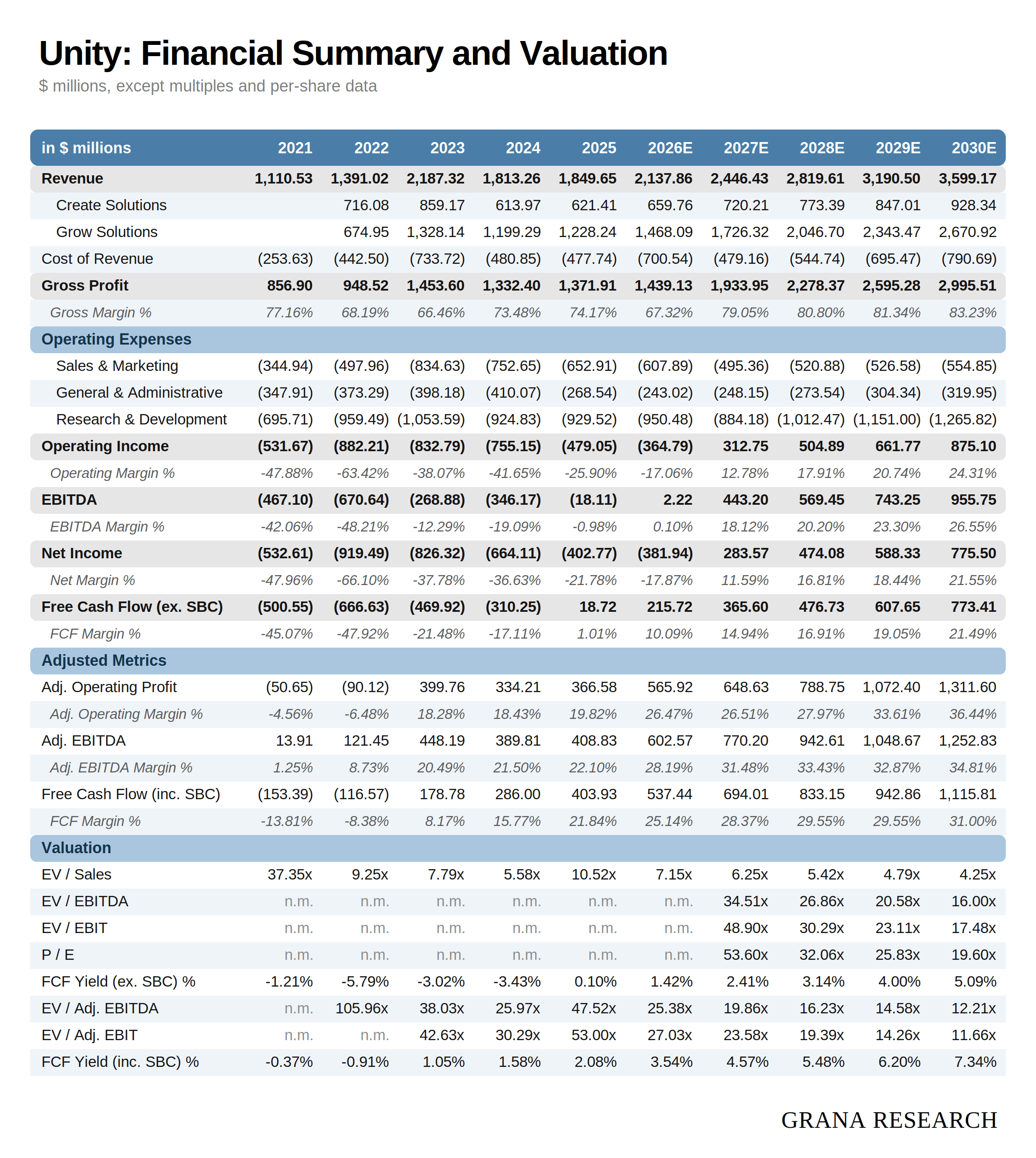
By 2025, Vector had already generated approximately $619 million in revenue, and Unity’s management expects the product to surpass $1 billion in revenue in 2026, implying roughly $400 million of incremental annual revenue. By comparison, the current sell-side consensus appears relatively conservative, forecasting annual revenue growth for the Grow Solutions segment of only $240-320 million through 2030.
As is often the case with companies of this kind, the majority of operating expenses are attributable to stock-based compensation. At Grana Research, we generally treat management’s adjusted financial metrics with a high degree of skepticism. Even when RSUs or PSUs have been granted but not yet vested, they still represent potential shareholder dilution and should therefore be taken into account.
Historically, Unity’s equity compensation plans included an automatic annual increase in the share reserve equal to 5% of shares outstanding. In December 2025, however, the board of directors approved a reduction in the annual share reserve increase to 2.5%. As a result, the company’s operating leverage is likely to improve meaningfully over time.
Even so, Unity’s current valuation does not appear particularly compelling relative to most companies in the advertising technology sector.
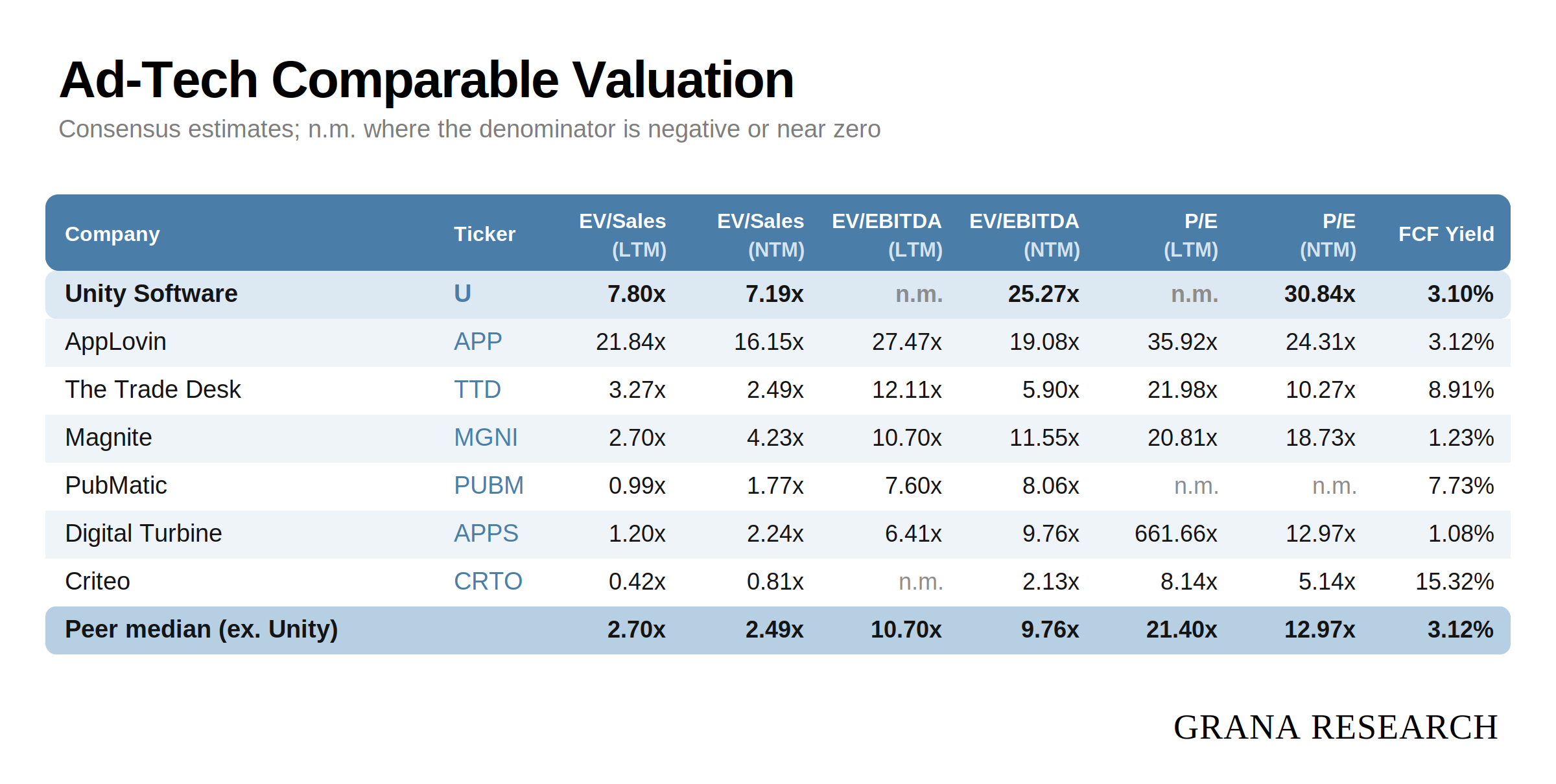
However, it is important to consider the economics of the advertising business. As advertising algorithms improve and return on ad spend (ROAS) increases, advertisers naturally allocate larger budgets to the platform until the marginal return on advertising converges with their target return. This flywheel was the primary driver behind AppLovin’s exponential growth following the launch of AXON 2.0 in the second quarter of 2023.
If Unity’s advertising performance can truly become competitive with AppLovin’s, it could represent an inflection point for both the company’s financial performance and its stock.
Disclaimer / Disclosures
The information contained in this report is provided solely for informational and educational purposes and does not constitute investment advice, investment research under applicable securities regulations, an offer to sell, or a solicitation to buy any security or financial instrument.
The opinions expressed in this report reflect the author’s views as of the date of publication and are subject to change without notice. This report has been prepared without regard to the specific investment objectives, financial situation, or particular needs of any individual investor. Readers should conduct their own independent research and seek professional financial, legal, tax, or other advice before making any investment decision.
The analysis presented in this report is based on information believed to be reliable, including publicly available sources, company disclosures, industry publications, and discussions with market participants. While reasonable efforts have been made to ensure the accuracy of the information, no representation or warranty, express or implied, is made as to its accuracy, completeness, or reliability. Any estimates, assumptions, or forecasts represent the author’s judgment and are inherently subject to uncertainty.
This report contains forward-looking statements, including expectations regarding future financial performance, industry trends, market developments, and company prospects. Such statements involve known and unknown risks, uncertainties, and assumptions that may cause actual results to differ materially from those expressed or implied. No assurance can be given that any projections or forecasts will be realized.
The author may hold, establish, increase, reduce, or dispose of positions in any securities discussed in this report at any time without prior notice. Such positions may create potential conflicts of interest. Nothing in this report should be interpreted as a recommendation to buy, sell, or hold any security.
To the fullest extent permitted by applicable law, the author disclaims any liability for any direct or indirect loss arising from the use of, or reliance upon, the information contained in this report.
Grana delivers again!
I just took a brief look at the numbers, one thing stands out.
Free cash flow increasing every year for the last five years. 50% CAGR the last two years, revenue is flat from 2024 meaning the cost cutting you were speaking about is clearly working.
Will have to look into this one more closely, definitely enjoyed it!
Thank you :)
appriciate the research, did you get the interviews from expert calls